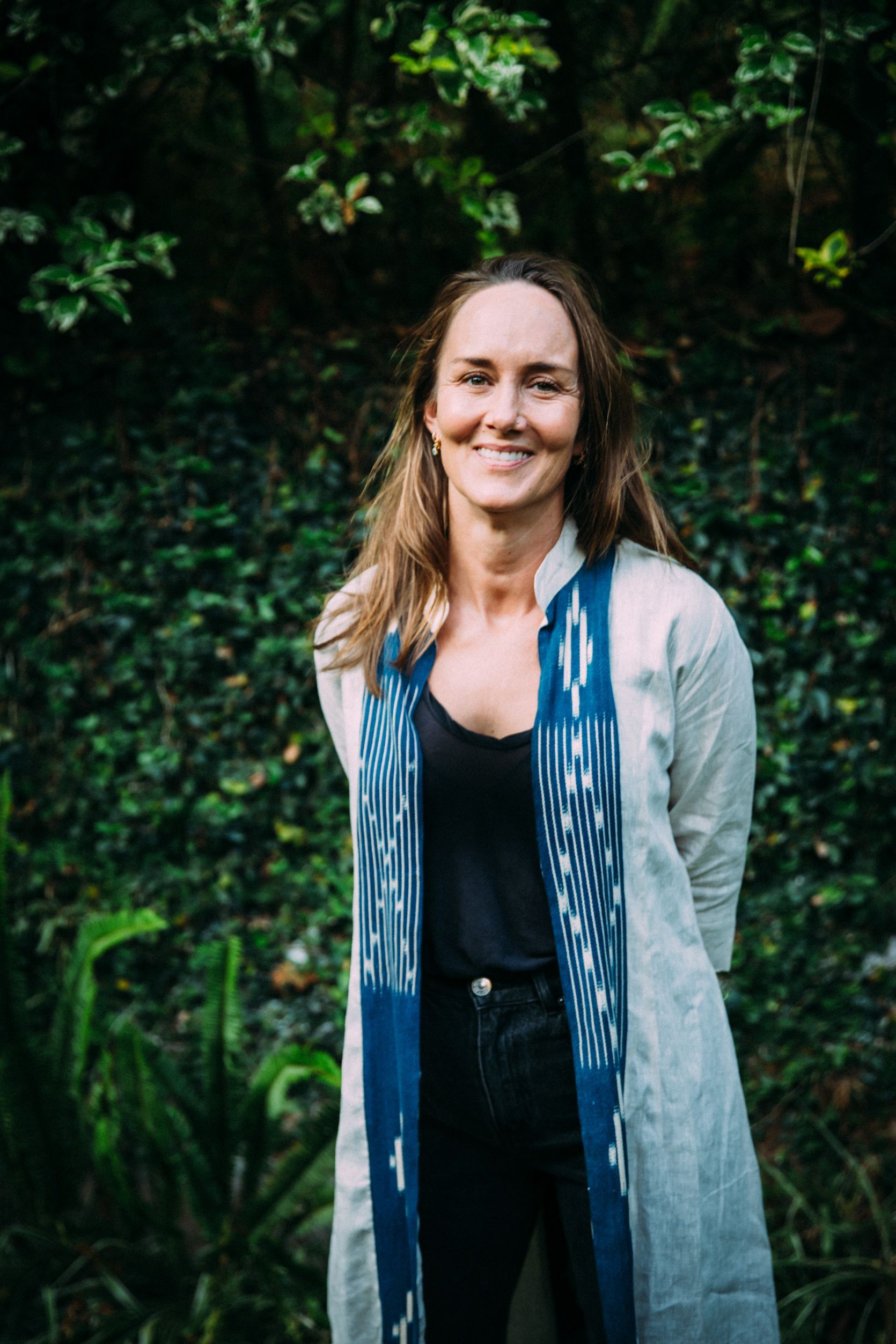
“People meet me and say, ‘You’re so serene. You’re so calm.’ And I think, you don’t know me—you haven’t met the fire yet,” Lauren Evans says.
She’s right. To understand her is to hold her dualities: soft and firm, analytical and intuitive, tender and fierce, driven by empathy and standing up to injustice. Hers is not a story that unfolds in a straight line.
It starts in the urban neighbourhood where she grew up in Stockwell, South London.

“Even though I never really got to experience nature, I always felt it at the core of my heart,” she says.
Recently, she found an old diary from when she was about nine years old. On one page, she’d drawn herself in a field, growing carrots. There were animals in the background. Underneath the drawing, in shaky childhood handwriting, was a caption: When I grow up, I want to be a conservationist.
***
At university, she registered as a psychology major and a zoology minor.
“It’s always been those two things for me,” she says. “The natural world and the human experience.”
But the psychology she encountered in her first year felt a little too clinical, too far from the layered human truths she was drawn to.
Zoology, on the other hand, offered a way into the natural world. So she leaned more into that, all the while keeping her fascination with people, emotion and complexity alive.
That duality of the human and the nonhuman would become the thread that eventually pulled her toward a very different way of doing conservation work.
But before that, Lauren followed the well-trodden path into the field. After university, she interned and volunteered, and eventually landed in East Africa to study elephant behaviour.
She loved the elephants, the open spaces, and the privilege of being immersed in those ecosystems. But things didn't feel quite right.
“The separation of nature from humanity really troubled me,” she says.
So, as she often does when she feels discomfort, she went deeper.
She pursued a master’s degree in Tanzania, where she examined hunting tourism and its impact on affected communities. From there, she went for a PhD in political ecology.
“The idea that any ecological or environmental issue is inherently and fundamentally political really resonated with me,” she says.
For her research, she chose Laikipia in Kenya, the former White Highlands that are still shaped by colonial history, land inequality and contested ownership.
Her study focused on elephant fences. On the surface, it was straightforward wildlife management. But Lauren was never interested, only on the surface.
She wanted to know what these fences mean to pastoralist communities who feel they have an ancestral right to land they can no longer access. What they mean to white landowners whose families acquired vast estates during British colonial rule. What they mean to the elephants themselves.
“I started to see elephants not just passive recipients of conservation action, but independent political actors that were pushing against these human-made boundaries and co-creating their own conservation,” she says
By her own admission, this was a bold idea, but it excited her. More than anything, it allowed her to hold people, wildlife, history and power in the same frame.
***
After her PhD and postdoctoral work, Lauren worked for a mainstream conservation NGO in Kenya. On paper, it looked like a dream job. The organisation worked on elephants. The mission sounded noble. But living inside the machine was different. Once again, Lauren felt disillusioned.
She felt as if her presence and expertise were a way to retrofit a sense of legitimacy onto projects that, at their core, were not designed to truly listen.
She saw how patriarchal the conservation space often was. How those who held the money and power made the decisions, and those who didn't were tokenised.
“There’s so much rhetoric about community work and inclusion,” she says. “But often there is very little patience to really listen, to really sit with nuance and genuinely value different experiences.”
She stayed at the organisation for practical reasons: children, financial realities and responsibilities.
“But in my heart, I always knew it wasn’t right,” she says.
***
Then her life imploded. Lauren suddenly found herself a single mother of two young children.
She remembers the day it all came crashing down.
“It was really hard, but strangely, it was also this lucidly clear moment of, ‘Okay. Now it’s time to live a life that is truly aligned with my values and never compromise on that again.’ I remember standing in my kitchen and thinking, It’s now time to move forward in alignment,” she says.
And in moving forward, something new was born.
Together with a close friend, Lauren began imagining a different kind of conservation space that acknowledged complexity, conflict and humanity. Over time, that idea became a for-purpose organisation called Human Nature.
Using dialogue, mediation, nonviolent communication and conflict transformation, Lauren works with conservation actors, from communities to NGOs, governments to landowners, to sit together and see one another not as opposing sides but as human beings.
Because when it comes down to it, how we behave and how we relate is central to how we treat nature.
***
Lauren’s work is also a mirror of her inner landscape.
In her family, in friendships and in professional spaces, she has always been the person who could see all sides, hold everyone’s pain and help people move through conflict. Even as a child, when there were family dilemmas, she was the one trying to make people see each other’s point of view.
It’s been a gift. And it has come at a cost.
“I think the difficulty has been untangling ‘being empathic’ from losing myself,” she says. “I firmly believe in what I believe. But in the past, I was more afraid to stand up for it and speak loudly, because I was so used to playing the role of the one who understands everyone else.”
Part of her journey now is giving herself permission to be both: the woman who can sit with someone’s pain and genuinely see them, and the woman who will say, "No. This is not okay.”
How is that going so far?
“I think it’s about not caring so much about looking confusing to people,” she says. “About letting go of how I should be and just being who I am.”
***
Ask Lauren what her ideal world looks like, and she doesn’t immediately describe a postcard scene of humans and wildlife in perfect harmony. Instead, she talks about how we get there.
“I’d love to see people coming up with solutions in a truly inclusive way,” she says. “Where more marginalised voices are genuinely heard. Where more authoritarian voices don’t always dominate. Where the full spectrum of experience is acknowledged, and consensus is created together.”
She knows some may roll their eyes at this. That they might say it’s too idealistic, too naive in a world that has been built on capitalism, patriarchy and power-over.
She doesn’t agree.
“Fundamentally, I believe humans can collaborate,” she says. “That’s why I do the work I do.”
In many ways, Lauren Evans is still that little girl in Stockwell who drew herself in a field, planting carrots, surrounded by animals. Only now, the field is full of other characters too: pastoralists, landowners, NGOs, donors, government officials, children…
What has changed is not the longing, but the scale. And the courage it takes to stand in the middle of it all.
“I try to live fully,” she says. “I live deeply. I feel a lot, and it’s not always the good stuff. But as I’ve grown older, I’m learning to embrace all of it.”
An empath. A warrior. A scientist. A humanist. And perhaps most importantly, Lauren is a woman who refuses to choose one among any of these truths. Because she carries all of them at once.
***
This interview is part of a series profiling the stories of the 2025 WE Africa leadership programme fellows. African women in the environmental conservation sector who are showing up with a strong back, a soft front, and a wild heart.
***
About Lauren Evans
Lauren Evans has worked in conservation, always in an interdisciplinary way, in East Africa for 15 years, where tensions between social justice and conservation can be glaring.
Lauren’s PhD and post-doctoral research examined the political ecology of electrified ‘elephant’ fences in Laikipia, Kenya: the politics they both represent and create. Lauren delved into issues of identity and access in relation to land by pastoralists and conservationists, and looked at elephants as political actors. She then directed the conservation science department for a Kenyan-based conservation NGO for six years.
Increasingly, Lauren felt a drive away from the top-down, market-based, protectionist solutions she faced. So she set up Human Nature: a for-purpose organisation that helps conservation organisations connect deeply with the people they work with, creating inclusive and lasting solutions that balance the needs of people and nature.
She has trained as an accredited conflict mediator and practitioner in nonviolent communication and restorative dialogue. Lauren wants to shake up the sector and create a solution that is led by connection, empathy and humanity.