“The first half of life is devoted to forming a healthy ego, the second half is going inward and letting go of it.”
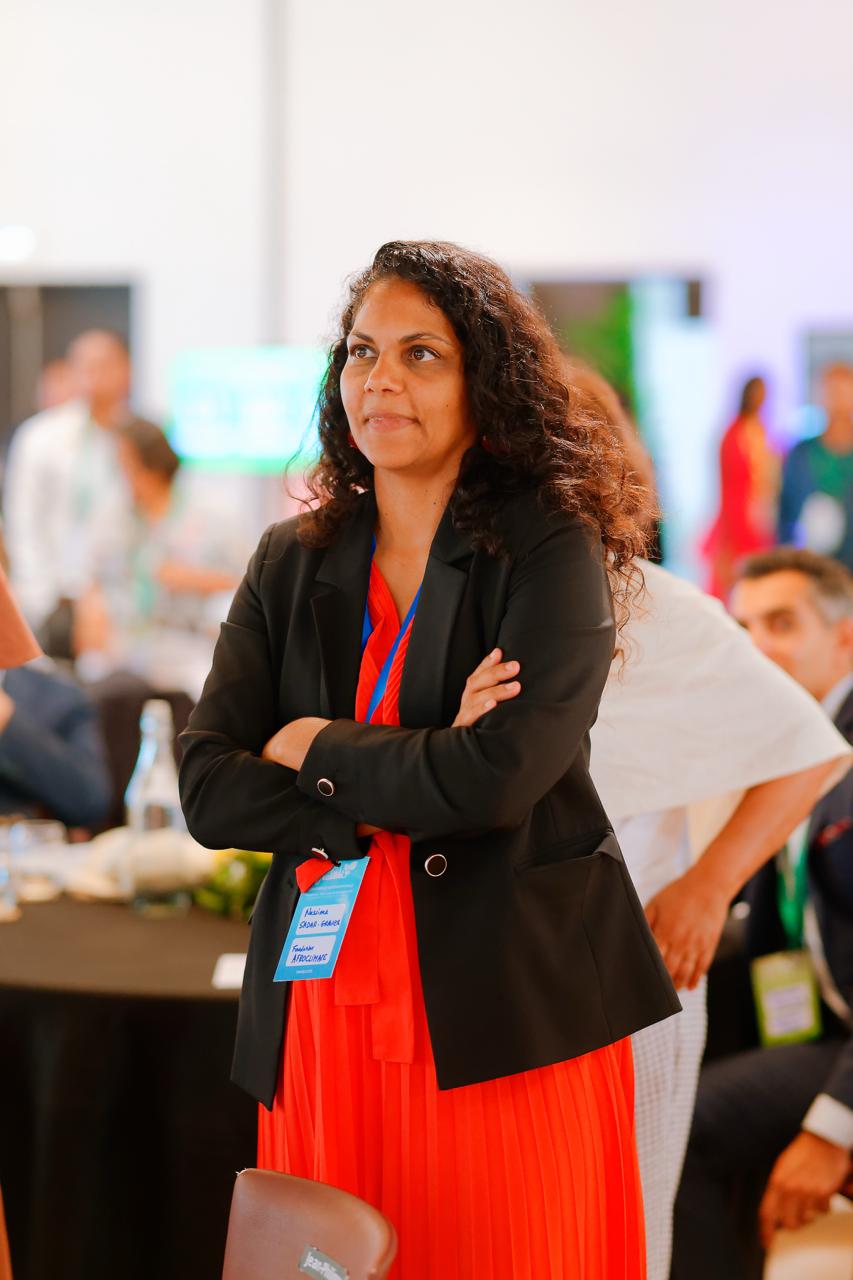
Listening to Nassima Sadar-Gravier tell her story, I can’t help but return to Carl Jung’s words. Her life has been a slow crossing from the bold, orderly world of achievement toward a quieter, less certain landscape inside herself. She speaks of it gently. As if she is still learning the path even as she walks it.
More than a reinvention, she calls it a becoming.

To understand that becoming, we have to go back to the curious island girl who imagined a world larger than her immediate horizon.
***
Nassima was born and raised in Reunion Island in a mixed-heritage family. When she turned 21, curiosity got the better of her, and she left for France to further her studies and work. Very quickly, she realised that life didn’t suit her.
“I did not like what they call métro, boulot, dodo. You go to work, you sleep, you repeat,” Nassima says.
The restlessness that had first carried her away from the island found her again. This time it took her to Vietnam, then Singapore, and later Australia. After more than twelve years of living on the move, Nassima turned back toward home and settled in Mauritius.
“My parents were getting old, and I needed to be close to them,” she says.
She spent the next 5 years as a partner at a private equity firm that invested in small and medium-sized enterprises across six East African countries. The work was prestigious and demanding. Her journey up until this period represented what Nassima calls “the first part of her life”.
***
The second part began with two things: the birth of her first son and her “climate awakening”.

Nassima was thirty-seven years old. The year was 2019. As an islander, she was already witnessing stronger cyclones and sudden floods; the weather was becoming less predictable. Then, she reflected on a statistic: in 2050, her son would be thirty-one and living in a world far more fragile than the one she had known.
“I felt called to be courageous enough to become an entrepreneur in the climate space,” she recalls.
She joined a partner who had founded a consulting firm called Living Labs Federation. During COVID, they began helping companies reduce their carbon footprints. Through that work, they gained a client, an international organisation that wanted them to create a curriculum for young entrepreneurs in blue economies and sustainable tourism.
“For the first time, I felt what it was to truly impact people from the region where I come from, and to impact the environment as well,” she says.
In 2023, she was selected for the Obama Leadership Program. True to her curious nature, she reached out to other leaders to understand the realities they were facing. What she discovered felt like “a big slap in the face”. It was her first honest encounter with climate injustice.
“When I talked with these entrepreneurs, what struck me was how they were able to help people and the environment with so little,” she says. “Looking back, I realised that many of the entrepreneurs I had supported in the past came from privileged families, even when they were from the poorest countries. And a majority of those addressing the issues of the most affected communities were struggling to access tailored expertise. So, again, courageously and fearlessly, I told myself, I am a strategic thinker; I have the ability to map things out and connect the dots. What I need to do is set up a foundation to support these entrepreneurs.”
And with that declaration, AfroClimate was born.
***
Nassima began by looking at her networks within the Obama Leadership Program Foundation. There was a community of 1,000 leaders, 400 of them in Africa. Some were social entrepreneurs; others worked in the NGO space, the public sector and various foundations.
“I was like, it’s easy, we just need to understand their needs, connect them and plug them into different areas,” she says.
In her first year, she onboarded 10 leaders and received support from 23 global mentors, who contributed countless pro bono hours to entrepreneurs on the front lines of the climate crisis and biodiversity loss. Out of those exchanges emerged a methodology to support climate entrepreneurs in Africa, with a 360-degree approach built on six pillars: capacity building, media visibility, market access, funding access, impact measurement and specialist mentorship.
Today, AfroClimate has grown to five full-time employees and 50 mentors. Additionally, 20 incubators and 20 enterprises have been onboarded, including social businesses, NGOs and community-based organisations.
“It’s been an amazing journey,” Nassima says. “I’m in total alignment with what I do.”
At thirty-eight, she felt she had finally found her path. Two years later, she welcomed her second child. Both beginnings affirmed, to her, that growth does not retire with age.
“I recently did an interview for the Obama Foundation,” she explains. “They’re preparing to open President Obama’s Presidential Centre, and they’re sharing my story to show that it’s never too late to choose work that truly aligns with your values.”
***
And the change she speaks of goes beyond surface level. She describes it as a deeper personal orientation. Her philosophy has shifted from the individual to the collective. She believes that healing the planet goes hand in hand with healing ourselves, and that progress depends on people working together. Going deeper, her philosophy is shaped by her observation that many of us arrive in this world carrying wounds that will awaken in their own time. The question then becomes: how do we help each other?

She brings this awareness into AfroClimate by offering qualified therapists and well-being support to entrepreneurs and to her own team. This is optional and separate from funding or performance decisions. What matters, she says, is offering the possibility.
Because the need is clear.
Most of the entrepreneurs AfroClimate works with show signs of burnout, yet many resist any conversation about well-being.
“We’ve organised masterclasses and people won’t come,” she says. “They tell us they’re too busy solving an issue at the company.”
When well-being sessions were integrated into a sponsored program, the facilitator asked what would happen to their companies if they collapsed first. The question prompted many to rethink the price of ignoring their own well-being.
For Nassima, this is really the heart of the matter: more than the business plan, there is the individual, the organisation, and the fragile human space where leadership lives between the two.
She remembers a pitching conference where AfroClimate brought four entrepreneurs to present their work. Among them was a woman she had known for some time. She was confident in her dress, generous to everyone and moved through the room as if she carried no fear at all. While the others treated the trip as a rare privilege, she seemed determined to show the world she had already arrived.
“Every time she spoke, she would use the same words: ‘I’m resilient, I’m resilient, I’m a resilient lady,’” Nassima says.
The more she repeated it, the more Nassima sensed something beneath the shine.
“Something in me recognised the weight she was carrying,” she says. “After the pitches were over, I went to her and told her, you don’t have to carry that much.”
Nassima could only say this because she had once lived it herself. “I know that in my own experience, the tension I held deep inside came from what I inherited from my ancestors.”
Nassima did not say all of this to the woman; she only shared her own sense that sometimes rejection or abandonment in childhood can harden into a strength that hurts.
The woman burst into tears, and that moment became the doorway to a more meaningful journey. AfroClimate connected her with an external professional coach, and, with her consent, the focus was on her for a period of time. It was a temporary, voluntary support alongside the usual work of building a business.
Slowly, the woman became lighter, more balanced, more honest about what she wanted. In the end, she chose to leave the startup and build a different career.
“It was not a failure that she left the start-up,” Nassima says. “She found better things that allowed her to be more herself…and this is just my reflection. When I see people so driven to be at the top, I sometimes wonder if there is something deeper they are working through, something they may not yet have had the space to face.”
***
The work has taught Nassima a lot about other people’s wounds, but motherhood has taught her even more about her own.
With her first child, the awakening was outward, focused on saving the planet. But with the second, she says, “I realised that the planet is going to survive. The dinosaurs died, and the planet continued. The real question is how will we, the human beings, survive?”
What motherhood has humbled her to accept is that she cannot shield her children from every challenge life will bring. Even if she teaches them things like self-respect, self-love and self-esteem, life will bring its own challenges, and she will not always be there to soften the fall.
So she chooses to meet them honestly. When she is tired, she says so. When tears come, she lets them see. She wants them to grow up understanding emotions, not fearing them.

Her hope is not to protect her children from pain, but to give them a way to meet it, so that one day they can face their own challenges with kindness instead of fear.
Talking about this now carries her back to her own childhood. “I must have been nine or ten, and I used to wonder, why didn’t our parents give us a manual about life?”
About two years ago, she decided to create, for her children, what she had once longed for.
“Whatever wisdom I found through reading or learning, I was doing it for me. Then I thought, why don’t I do this for my children, to give it to them when they are sixteen or eighteen?”
She began writing a journal for each of her sons. “For my first, I went quite far. I observed the day he was born, the time, and what I was feeling as I wrote. Everything that might help him later to understand himself better.”
One day, she imagines, her children will look back and see those journals as gifts.
She clarifies that these letters are not necessarily profound; they can be about anything she wants to tell them in the moment.
Two months ago, she wrote a simple line to one of her sons: “Today, you made me so proud of you. I love you.”
Towards the end of our conversation, she reads me a poem she recently wrote.
We come on earth to experience. We learn from our parents how to navigate and how to survive to our basic needs: Eating, being clean, having access to water, having a roof, but also love and protection.
Some of these needs are met, and others are brushed aside.
We learn to navigate life with these unfulfilled needs. Life will orchestrate itself with characters that will activate these unfulfilled needs and wounds.
Until we learn and take responsibility for fulfilling our needs and our life to the fullest. Grace, patience, love and compassion will dissolve the shields and masks we've built to protect ourselves.
Pain will arise along with the sadness of accepting that only us could give ourselves all the love and attention we need to feel safe, to finally be who we are and who we are meant to be in this lifetime.
Life will shake us with departures of our loved ones to remind us how precious she is as a gift and how lucky we are when we let it be, and let it flow without trying to control or to abuse it.
These lines, Nassima says, are the closest map she has found to the way she wants to live.
***
This interview is part of a series profiling the stories of the 2025 WE Africa leadership programme fellows. African women in the environmental conservation sector who are showing up with a strong back, a soft front, and a wild heart.
***
About Nassima Sadar-Gravier
Nassima is a social architect transforming fragmented local initiatives into investable ecosystems across Africa. She co-founded Mo Angels and Living Labs Federation, channelling early-stage capital, mentorship, and global networks to emerging entrepreneurs tackling the continent's most pressing challenges.
With a background as a private equity partner, she brings investment acumen and deep commitment to the blue economy and sustainable development. She serves on the board of Oceanhub Africa and now leads her climate work through AfroClimate.
Nassima is an Obama Leader 2023 and WE Africa 2025 fellow.