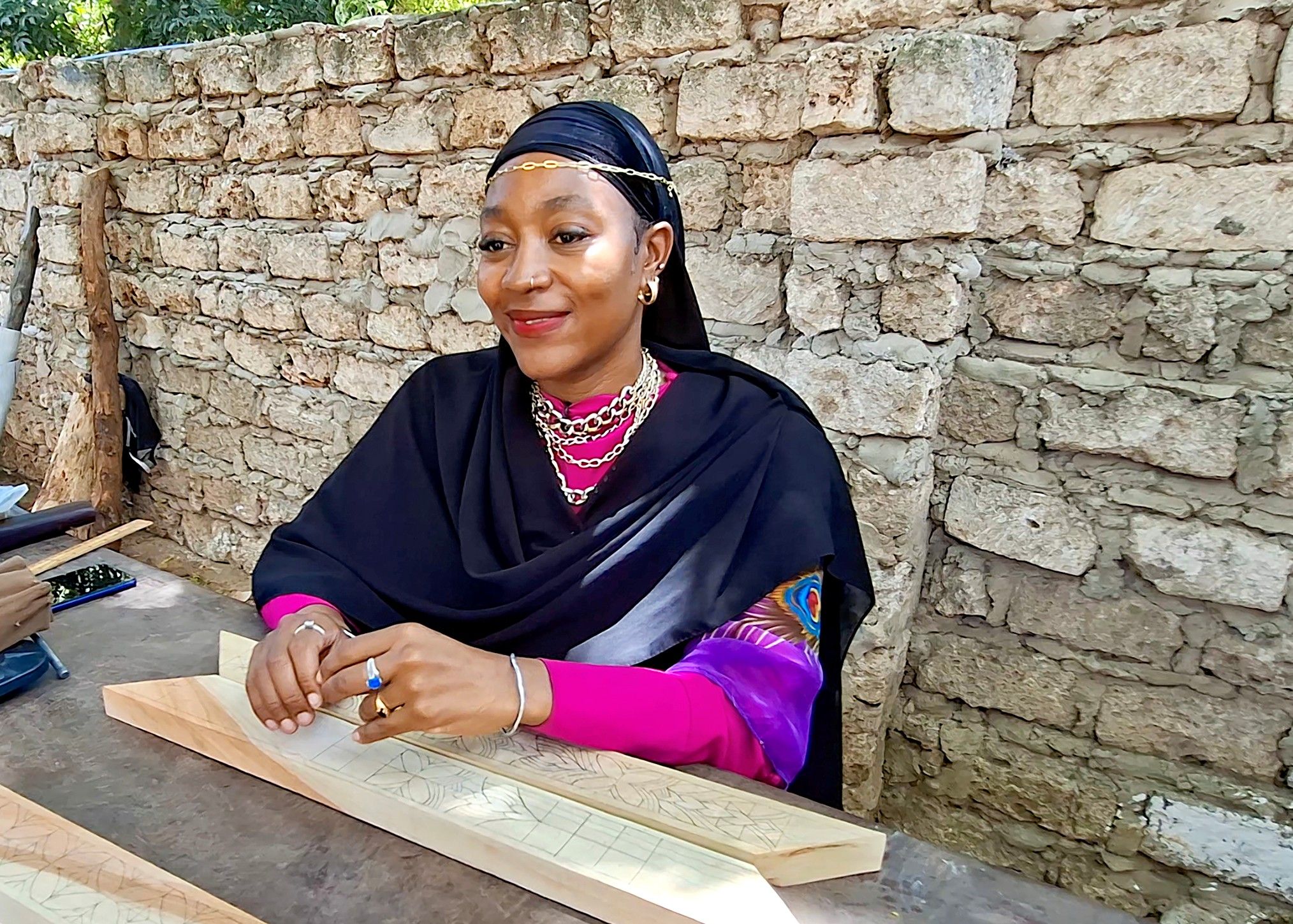

More women in Namibia have access to financial services, but can they borrow to grow a business or manage an unexpected expense? Economist and entrepreneur Sesilia Nekwaya-Okafor is looking beyond the numbers to understand what women need and where they still struggle.

By Timo Shihepo, bird story agency
As a young intern at the Bank of Namibia a decade ago, Sesilia Nekwaya-Okafor helped prepare a survey that sparked a question still guiding her work: does having access to financial services mean people are benefiting from them?
Today, as a principal economist at the bank, she uses data to understand who benefits and who remains underserved, particularly women, rural communities and informal businesses.
“One of the biggest lessons for me has been that access to financial services does not necessarily mean that people's financial needs are being met,” she says.
That focus also informs her work with the Alliance for Financial Inclusion (AFI), where she helps policymakers measure whether financial services improve people’s lives. In 2026, AFI recognised her contribution to its Financial Inclusion Data and Impact Working Group with its Technical Leadership Award.
The Bank of Namibia received AFI’s Institutional Leadership Award for its policy work and contribution to learning among member institutions. Both awards were presented at the AFI Global Policy Forum in Port Moresby, Papua New Guinea.
“National averages don't always tell us the full story,” she says. “We may report that a high proportion of women are financially included, but what does that actually mean for a woman running a small business in an informal settlement? Or a woman engaged in agricultural activities in a rural community?”
Her concern is that women are often treated as one group despite their different financial circumstances. A formally employed woman in Windhoek may have relatively easy access to banking services, while a woman running a market stall or a small farm may face irregular income and limited access to finance.
“Without breaking data down by gender, age, and exact location, policy remains blunt,” she says.
Her interest in these questions is rooted in her upbringing.
“I am a product of Namibia's informal settlements. I grew up in one of Windhoek's underprivileged communities, in a single-parent household. My mother raised five children with very limited resources, but one thing she was absolutely committed to was our education,” she says.
A Bank of Namibia bursary she received while still in high school became a significant turning point.
“It created opportunities that might otherwise have been difficult to access,” she says.
The experience shaped her understanding of financial inclusion and economic empowerment.
“I don't think about them only as policy concepts. I understand, from my own experience, how access to opportunity can change someone's circumstances,” she says.
Her understanding is also informed by her experience outside the central bank. For the past five years, she has co-managed Mrs Okafor’s Kitchen, a restaurant she co-founded. The business has employed five women and provided opportunities for practical skills development.
Running the restaurant has exposed her to the pressures facing small businesses, including managing cash flow, meeting operating costs and accessing finance.
“I often find myself looking at issues from two perspectives: as an economist involved in financial sector policy, and as an entrepreneur experiencing some of the realities that those policies are intended to address,” she says.
Beyond having a bank account
Namibia’s financial inclusion figures show considerable progress, but they also demonstrate why overall access rates should not be the only measure of success.

According to the 2025 Namibia Financial Inclusion Survey, released by the Namibia Statistics Agency (NSA), the country’s financial exclusion rate fell to 14%, from 22% in 2017.
Women recorded higher overall financial inclusion than men, at 87.6% compared with 84.2%. In 2017, the corresponding figures were 79.8% for women and 76.1% for men.
However, overall inclusion does not necessarily mean equal access to individual financial products. Yet 11.7% of women borrowed from formal banks, compared with 14.1% of men.
The difference does not establish a statistically significant gender gap in borrowing, but it illustrates why financial inclusion needs to be examined beyond account ownership.
The 2025 survey also found that 72.7% of women reported saving, compared with 72.2% of men. Financial exclusion remained higher in rural areas, at 20.7%, compared with 8.3% in urban areas.
For Nekwaya-Okafor, the important question is whether people can use financial services regularly, afford the costs and access products that meet their needs.
A woman may have a bank account and save regularly, she says, but still struggle to obtain credit to expand her business or protect herself against unexpected financial difficulties.
This distinction is reflected in the experience of Hildeberth-Grace Haingura, a Windhoek-based student and entrepreneur who runs Grace Tenaah Elegance, a handmade beaded accessories business.
Haingura developed an interest in art by turning simple materials into valuable products. But building a business while studying has brought financial challenges.
“Sustaining my business has not been easy, especially because I am a student and I am building the business with my own limited resources,” she says.
Access to finance remains one of her biggest obstacles.
“Having the creativity and the desire to grow is one thing, but having the financial resources to purchase materials in larger quantities, improve production, market your products, and participate in exhibitions is another,” she says.
For now, she reinvests money from orders into the business and uses affordable marketing methods. Growth has been gradual because she cannot commit resources she cannot afford to lose.
Haingura believes young entrepreneurs need practical business training, better access to markets and opportunities to exhibit their products. She also wants information about available support to be easier to find.
She accepts cash and wallet payments but does not have a card machine.
“I wish there were funds allocated to women in business or to support women in business,” she says.
Her ambition is to secure a dedicated workspace or small shop, strengthen her online presence and increase production while maintaining the quality of her work. She also hopes to create employment and training opportunities for other young people.
Measuring what changes
For Nekwaya-Okafor, collecting data is only part of the work. The information must help determine whether policies and interventions are improving people’s circumstances.
Her involvement in Namibia’s Financial Sector Strategy strengthened her interest in measuring the results of financial sector policies.
She contributed to the monitoring and evaluation framework for Namibia’s Financial Sector Transformation Strategy, including a scorecard with approximately 120 indicators to track progress across different areas of financial sector development.
“Because it's one thing to say that we've introduced a policy, conducted workshops or implemented a particular intervention. But how do we know that people's circumstances have improved as a result?” she says.
The Bank of Namibia is also processing data from the 2025 Financial Inclusion Survey, which she hopes will provide further insight into the experiences of underserved communities.
Her work extends beyond Namibia through the Alliance for Financial Inclusion (AFI), a global network of policymakers and financial institutions working to advance financial inclusion.
Nekwaya-Okafor serves as co-chair and gender focal point lead of AFI’s Financial Inclusion Data and Impact Working Group (FIDIWG).
Making inclusion meaningful
Nekwaya-Okafor says the challenge ahead is to ensure that improvements in financial inclusion translate into practical opportunities for people who remain underserved.

For women running small businesses, this could mean more accessible financing, affordable financial products and services that recognise irregular income patterns. For rural communities, it could mean addressing geographical and other barriers that prevent people from using financial services regularly.
Looking beyond the averages is an important step towards understanding those needs.
Haingura continues to build her business with the resources available to her, balancing her studies with orders and the demands of entrepreneurship.
“One of my biggest lessons has been that passion alone is not enough; you also need discipline, patience, and the ability to keep going even when business is slow,” she says.
Her experience illustrates the difference between being counted as financially included and having access to services that can support a business’s growth.
The numbers may show how many people are included in Namibia’s financial system. The more difficult task is establishing whether that inclusion is making a meaningful difference in their lives.
A decade after that first survey, Nekwaya-Okafor is still asking what access means in everyday life. For women like Haingura, the answer lies in whether they can buy materials, grow their businesses and cope when sales slow. That is the test she wants the numbers to capture.
bird story agency