Madagascar is one of those countries where you can’t help but think God spent a little extra time getting the details just right.
The contrast alone takes your breath away. Turn left, and you get endless, pristine beaches. Turn right, and you are swallowed by forests so otherworldly they feel like portals to another realm.
When it came to deciding where to spend their holidays, Seheno Andriantsaralaza’s family always turned left. Seheno, meanwhile, was firmly “team right”.

And because she was too young to sway the family vote, she followed along. But even as she played on the beach, her heart wandered toward the forest that was calling her name.
***
She was a solitary child. Quiet too.
But as the eldest of three sisters, her father always reminded her that it was her role to stand up and speak up for the family.
That role became even heavier when he passed away. He had been ill for ten long years, and her mother, having carried so much during that time, was left physically and emotionally drained. So it was Seheno who held the family together.
“It was a very difficult time,” she says. “But my mother always kept saying to me that every day is a challenge, and I must never give up.”
More than that, her mother told her to never stop learning and dreaming.
Seheno carried that advice like a compass. But every time she opened her mouth to share her dreams, someone, somewhere was ready to shrink them.
“I want to learn more about nature conservation,” she once announced.
“You’ll waste your time,” they told her. “There are no job opportunities in that.”
They were wrong.
Later, she shared another dream.
“I want to study for my PhD,” she proclaimed.
And, again, the chorus of doubt rose around her.
“You’ll never find a husband,” they warned.
But once more, they misjudged her.
Seheno earned her PhD and married a man who stood beside her through every step of that demanding journey, both financially and emotionally.
***
Her path into conservation began after high school, when she chose to study at the Faculty of Sciences at the University of Antananarivo…against everyone’s advice.
During her master’s program, she travelled to western Madagascar for the first time. It was there that her destiny snapped into focus.
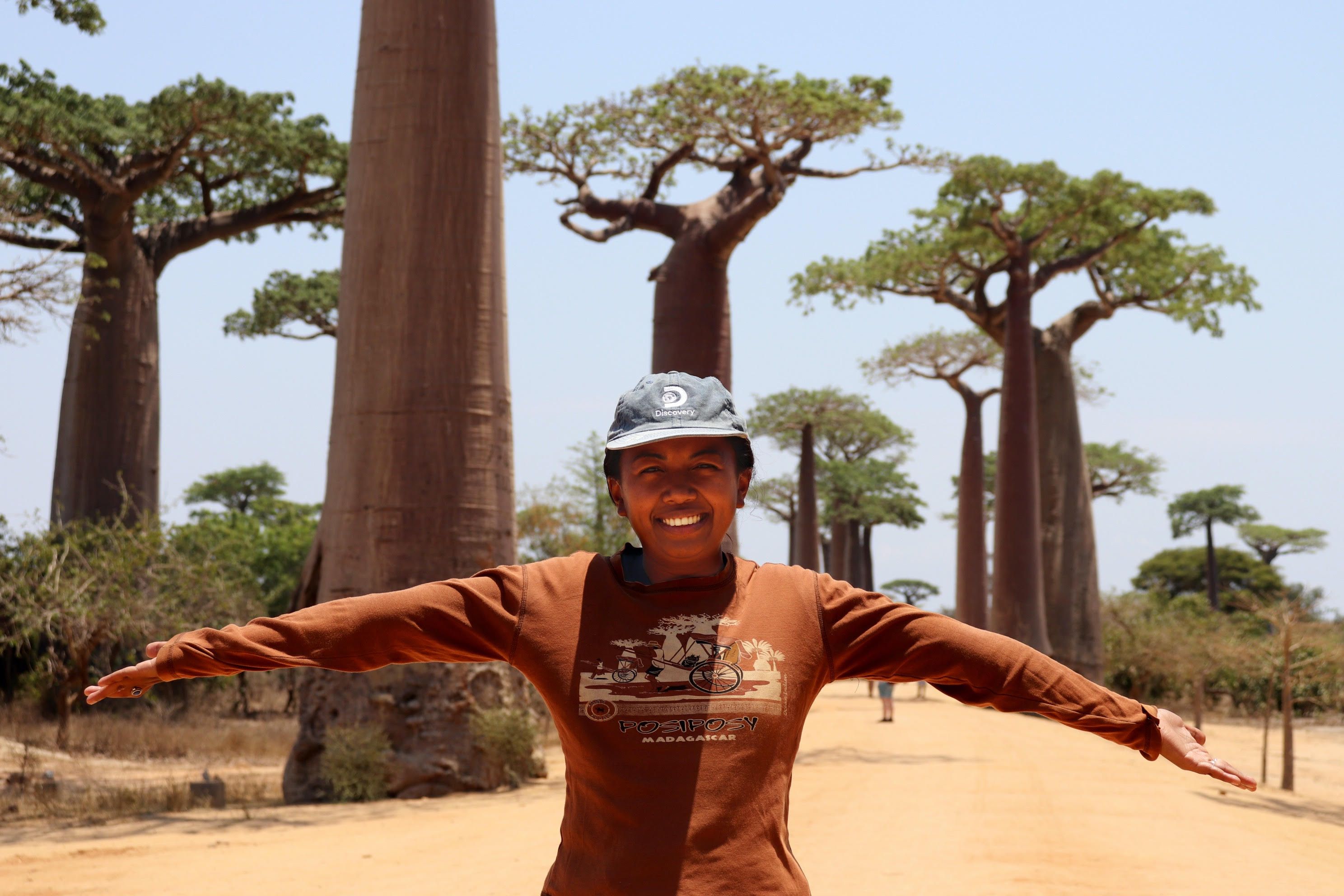
“I saw these giant Baobabs for the very first time, and I was just… wow,” she says. “I wanted to know everything about them.”
She had grown up hearing stories about them. But the reality, the sheer presence of these ancient beings, some of which were over a thousand years old, was breathtaking.
As she delved deeper into baobab ecology, one question refused to leave her mind: why were there no small baobabs? She saw the ancient giants, but never the younger ones.
Then she came across a scientific paper that offered an explanation: the giant lemurs that once spread baobab seeds had gone extinct. With them gone, the trees struggled to reproduce.

“I wanted to understand this mystery of dispersal,” she says. “So I became obsessed with how trees and animals rely on each other.”
A PhD was the next step in understanding the world that had chosen her.
With no financial aid, she worked throughout those five years, teaching, consulting, taking any small job she could to fund her research. Her partner (now husband) supported her emotionally and financially when she had nothing left to give.
After completing her doctorate, she faced a difficult choice: Stay with her husband, whom she had married just a week earlier, or take a job as the technical coordinator of a baobab reserve in the far south of Madagascar.
She chose the job.
“It was a huge sacrifice,” she says. “But nothing great comes without sacrifice. I believed in the direction it would take me.”
That reserve also housed a Lemur Rescue Centre, where confiscated pet lemurs were rehabilitated. She had to learn about lemurs quickly. Studying them deepened her understanding of the ecosystems she cared about and the collective work needed to protect them.
Looking back at that year, she smiles.
“It gave me experience, networks and knowledge I still use today. If you asked whether I’d make that choice again, I’d say yes. Of course.”
***
Today, Seheno is the Director of Operations at Fanamby, one of Madagascar’s leading homegrown conservation organisations. Fanamby co-manages nearly 600,000 hectares of protected areas across the country. Her role has helped her understand something she now fiercely advocates for: Conservation is collective. She sees herself as the glue that holds teams, strategies and fieldwork together so the mission can move forward.
“No one can do this work alone,” she says.
But there’s another truth she carries just as fiercely, and that is the need for equitable research. When she speaks about it, you can hear the depth of someone who has walked that path herself.
“When a foreign institution invited me to work on baobabs, I found my passion immediately. It was a privilege. I know that. Many Malagasy students never get such a chance,” she explains.
“Often, foreign researchers arrive with their own ideas. They choose the topic. They decide the questions. Local students help, but they don’t own the research. They get a diploma, yes, but no sense of ownership or influence. And yet the research is happening in their own country and on their biodiversity. Yes, we need collaboration with foreign researchers. But it must be equitable. We have to shape the questions together so the research actually responds to urgent conservation realities.”
She pauses, then adds with conviction, “I really care about this. It’s something I will always fight for.”
Even though she calls her entry into research “a privilege”, her journey was anything but easy. And because she is a woman, many people felt entitled to tell her what she could and could not do.
Yet here she is today, having proved them all wrong. The little girl who longed for the forest is now one of the women shaping its future.
***
Seheno comes across as a very resolute woman. But she is quick to tell me that this wasn’t always the case.
“I was always like a chameleon, you know, changing myself to fit the environment I was in,” she says.
If she was in a room where academic titles mattered, she’d slip into that colour.
“But in other spaces,” she says, “I would never mention it. Never. There was a voice in my mind that said, If you talk about your PhD, people will think you’re arrogant. And then in other spaces, if I talked about baobabs, the voice said, No one cares about that.”
The WE Africa journey, she says, has helped her understand the real her.
“The way I think about myself has changed. I bring my values with me now. I care about baobabs. I’m proud of my PhD. I am a mother, wife, conservationist, researcher, advocate for equitable science…These are all parts of me.”
The doubts still creep in, as they inevitably will from time to time. And when they do, she returns to what she knows:
“When you know your values, when you know your cause, when you know what you care about, then you can overcome those doubts and stand strong in who you are,” she says.
In many ways, Seheno’s story mirrors the very landscapes of Madagascar she loves so deeply: a place where beauty thrives by holding many worlds together at once and then standing tall in its formidable, glorious self.
***
This interview is part of a series profiling the stories of the 2025 WE Africa leadership programme fellows. African women in the environmental conservation sector who are showing up with a strong back, a soft front, and a wild heart.
***
About Seheno Andriantsaralaza
I am a Malagasy biologist and conservation leader. I hold a PhD in baobab biology from the University of Antananarivo, where I have spent the past 15 years studying these iconic and resilient giant trees. I am also a passionate advocate for lemur conservation. Currently, I serve as the Chief Operating Officer at Fanamby, one of the largest local conservation organisations that manages nearly 600,000 hectares of protected areas. Alongside this role, I continue my scientific career as a research biologist at the University of Antananarivo, where I lead research on tropical dry forests and baobab ecosystems, ensuring that scientific insights translate into tangible conservation impacts.