
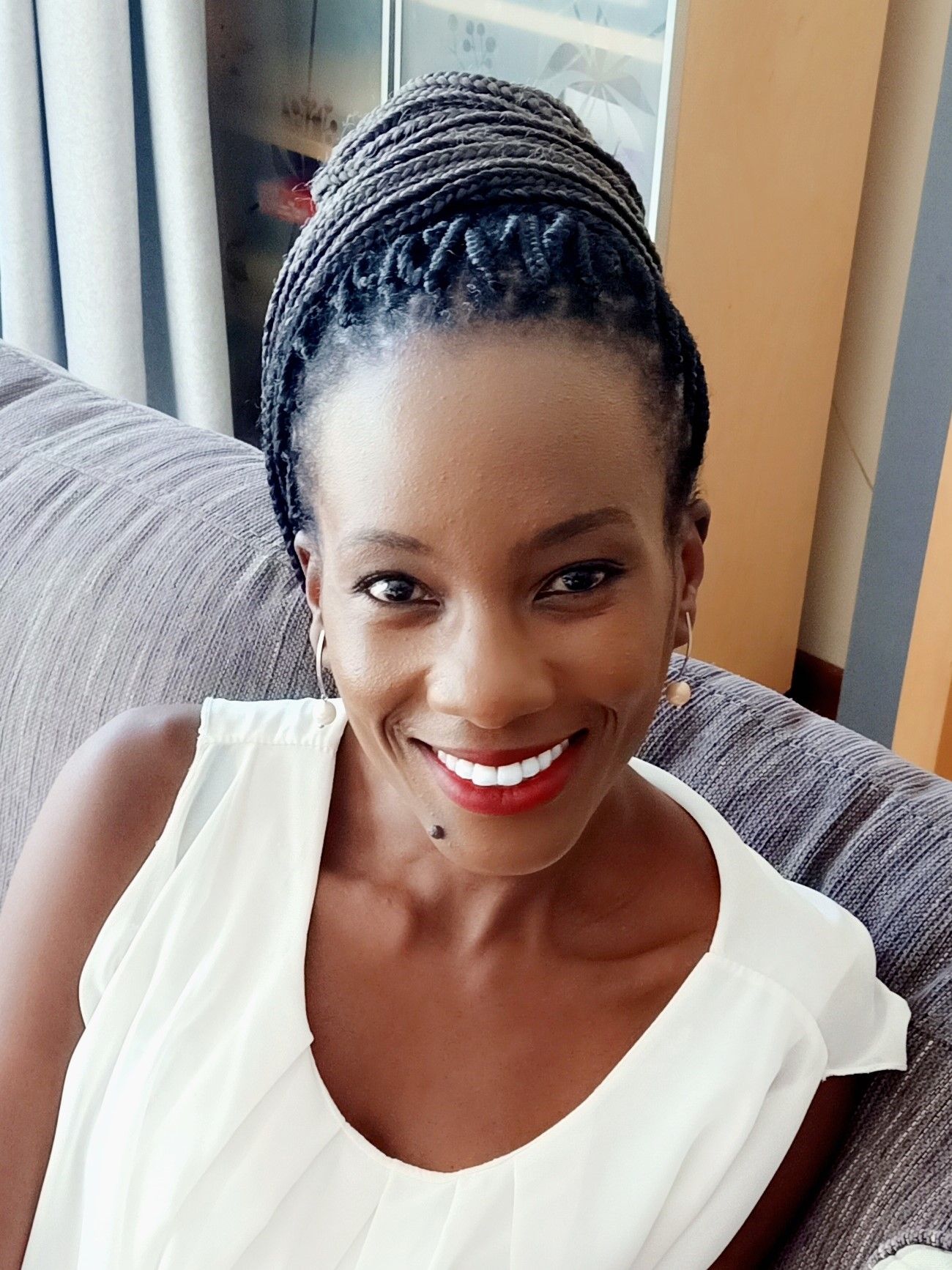
The routine was always the same: the school bell rang, students stood at attention and sang the national anthem. And then the Cameroonian flag was either hoisted or lowered. The person who carried out this duty was a boy. Always a boy. It didn’t matter which boy; it just had to be a boy.
But on this day, the bell had barely stopped ringing when twelve-year-old Fon Quinta Yuochi took off. She sprinted from her classroom to the flagpole, grabbed the rope, and began lowering the flag.
Around her, conversations froze. Students and teachers stared in disbelief.

“I was thoroughly beaten by the school administrator for doing that,” Quinta says, “But in my mind I was asking, ‘Why is it that only boys are allowed to do this?’”
She laughs now when she tells the story. But at the time, it stung. The beating hurt, yes, but so did the unfairness of it all. Quinta didn’t yet have the language to explain what she was feeling; she only knew something wasn’t right. It would take decades, and a long, winding journey through continents, careers and crises, for her to realise that this was the moment that defined her first act of advocacy.
***
Quinta’s second act of advocacy involved her younger brother. He had been sent to live with a male relative who had once lived with their family when she was a child. Being older, he had been the one in charge of discipline, but he often took that power too far.
“He used to beat us mercilessly,” Quinta says. “I wanted to tell him, ‘What you’re doing is not nice. Don’t do this.’ But I couldn’t. I was a child, and no one cared what I had to say.”
By the time she was a teenager, Quinta had stopped speaking to this relative altogether. But now her younger brother was in his care.
“I secretly went to see my brother, and he told me how badly he was suffering,” Quinta says.
She didn’t need much convincing; she knew exactly what this man was capable of. So, she scraped together some money, pressed it into her brother’s hands, and told him to run back home.
“My mother beat me seriously for facilitating my younger brother’s return,” she says. “But I just couldn’t let the abuse continue.”
That was Quinta. Still an advocate, but still not aware of it. What she was aware of was her compassion for others.
She didn’t come from a “golden spoon family”, as she puts it. Her father worked at the post office, and her mother was a farmer and petty trader. Quinta and her six siblings shared the realities of rural life: the ever-present dust, the cattle and pigs roaming nearby, and jiggers burrowing painfully into their feet…because shoes were a luxury they could ill afford.
But even in that scarcity, Quinta’s instinct was to help others.
“I was very moved by people who had less than I did,” she recalls. “Even though we didn’t have much, I would share my food and give my clothes to those who had none. I couldn't stand to see people in pain.”
***
At the university, she was accepted into a double major: gender and journalism.
“At first, I didn’t like that combination,” she says. “I wanted to study journalism. When they added gender, I was like, ‘Why gender?’”
Quinta hadn’t yet seen the pattern that was slowly emerging: stepping in for the vulnerable, and instinctively noticing who was excluded and who was hurting.
Her question would be answered over time.
***
In 2002, Quinta moved to the United States, where she trained as a home nursing assistant and spent years caring for elderly and chronically ill patients. Outside work, she served as secretary of the All Cameroonian Cultural and Development Foundation, co-founded the Cameroon Women’s Movement, organised fundraisers and cultural events, and helped connect Cameroonians with other African diaspora communities.
Even thousands of kilometres from home, the pattern remained the same: care, advocacy, community. Different place, same calling.
***
Thirteen years later, when she returned to Cameroon, she put her US experience to use by starting her own home-care service.
Then she walked into a local radio station to offer even more of her skills; this time using her voice. She created and hosted a programme called Embark and Excel, where she shared stories, encouragement, and practical guidance to inspire women to pursue opportunities for growth.

At the same time, she became the publisher of Equate Women’s Magazine, a print publication that lifts women’s stories, outlines their rights, and highlights the gaps and challenges they face in communities.
While all these pieces were moving, Quinta was also volunteering with the Centre for Human Rights and Democracy in Africa. Her dedication and skills quickly stood out, and she was soon offered a staff position as the organisation’s gender officer.
“That’s when it really dawned on me,” she says. “God was telling me, ‘See? This is your calling. You’ve been protecting the vulnerable all along.’”
She went on to co-found the Association for the Socially Vulnerable, a community-based organisation that protects people facing harm and hardship. This includes women, refugees and those living in poverty.
“When I meet someone who can’t pay their medical bills, I mobilise my network,” she says. “Very often, before long, we raise enough to pay for treatment.”
***
In 2023, the skies over Buea, the town Quinta calls home, opened. Heavy rains triggered severe flooding in parts of the town and surrounding communities. Homes were flooded. People died. Others lost everything.
“It was a shock,” Quinta says. “We did not have early warning systems. No one was prepared.”
As she and her colleagues moved through affected communities, conducting a needs assessment, a familiar pattern came into focus.
“Women were the worst affected,” she says. “And then, when the first official response came. About 99 per cent of those represented were men. You could see maybe one woman in the background.”
Quinta had long known that disasters are not gender-neutral. But seeing it play out in her own town pushed her into a new phase of activism.
She applied for a grant from Urgent Action Fund Africa, making the case that rural and indigenous women in Buea needed to be included in disaster management leadership from planning and prevention to response and recovery.
“They gave me technical support to refine my proposal,” she explains. “And then they awarded my organisation a grant.”
Working with partners, she helped identify and select women representatives from various rural and indigenous communities who intimately understood what it meant to lose homes, livelihoods and loved ones.
“In total, we had about 60 participants,” she says. “We sat them together with municipal officials in one dialogue space.”
In that room, women asked questions, shared ideas and challenged assumptions. And from that dialogue came a draft local disaster management policy that incorporated the voices and expertise of grassroots women.
“The municipality said they had a draft policy before,” Quinta says. “But we had never seen it. This time, women contributed to a draft that could actually work.”
And yet, like so many promising documents in systems strained by politics and misgovernance, the new draft policy sits waiting for validation.
“Governance is a big challenge,” she says. “Municipalities are afraid to make decisions without authorisation from the very top. So our work is still hanging.”
The “top” she refers to is a centralised political system that has long struggled with democratic accountability.
“It is a kind of dictatorship. Even if you want to carry out community activism, you can be summoned, jailed and made to pay a lot of money before you are released,” she says.
In that context, advocacy is both necessary and fraught. Push too hard, and you risk being silenced. Do too little, and nothing changes.
And because this matters to Quinta, she found a middle ground to keep the work moving.
She convened the Gender Actors for Sustainable Climate Action and Disaster Management network, a coalition of over 80 members, most of them women, committed to climate justice and disaster preparedness. Because they know that climate resilience can’t wait for policies to be stamped in distant offices.
“We have already achieved something important,” she says. “We opened access. Those grassroots women have now sat at the table with the municipality. They have contributed to the draft policy. They know their power. What we need is financial, material and technical support. There are many things we can do, whether or not the government validates the policy. But we cannot do them without means.”
And when formal means fall short, Quinta turns to music. She is a songwriter and singer who grew up creating what she calls “moral songs” with her brother. Her pieces convey messages about women’s rights, empowerment and dignity.
***
On the surface, Quinta’s life may look like a cluster of roles and responsibilities, but at the root, they all go back to the same calling.
And that calling is to care and advocate for those the world would rather overlook.
“I prayed for God to show me who He wanted me to be,” Quinta says. “Now I see it. I am that tree with many branches. And all of them are meant to give shelter to someone.”
She may not have a biological child yet, but she is a mother to thousands.
“People call me ‘Mommy Queen.’ Sometimes I tell God, ‘You need to give me a lot of money and resources so I can help all these people who come to me for help.’”
She laughs as she says this, but she means it. Her compassion is both her greatest strength and her heaviest burden. But no matter how heavy the burden gets, she will not step away from it. Because she believes this is her life’s purpose.
***
This interview is part of a series profiling the stories of the 2025 WE Africa leadership programme fellows. African women in the environmental conservation sector who are showing up with a strong back, a soft front, and a wild heart.
***
About Fon Quinta Youchi
Quinta Yuochi is a Cameroonian woman living in a mixed community of indigenous and rural populations.
She is a gender and environmental justice advocate. She is the visionary of the Association for the Socially Vulnerable (ASOV), which has its mission as the protection and promotion of the rights and welfare of persons whose conditions in life increase their vulnerabilities, expose them to harm or leave them needy.
Madam Yuochi is a 2025 fellow of the Women for the Environment WE LEAD Program. She is the general coordinator of the gender and environmental justice network known as Gender Actors for Sustainable Climate Action and Disaster Management (GASCADIM).
Madam Yuochi is a journalist; she's also the publisher of the EQUATE Women's Magazine, which is a strategy of her organisation's Program for Gender Equality known as EQUATE Women's Empowerment Program.
Madam Yuochi is a believer in the Christian faith and serves in the calling of an evangelist. She provides a combination of spiritual counselling and psychosocial support to underprivileged and needy persons in and out of Cameroon. She is the author of two Christian books, Thankfully Praying Isaiah and Praying and Praising.
Madam Yuochi is a song composer and singer, her strategy to promote peace, love, comfort, hope and joy. Some of her songs conveying these messages are Hash Tag Love, Every Woman is a Champion and Ti Bene.
Madam Yuochi is a member of many social networks aimed at promoting and protecting vulnerable groups and ecosystems, such as Safe Sisters Network and Cameroon Gender Watch (CAMGEW). She has built capacity in diverse disciplines, including gender-based violence prevention project management, reporting climate change with gender dimensions and digital safety for women's rights defenders and journalists.